
Kings Theatrical Society’s The Furies or The Kindly Ones, written by Aeschylus and directed by Sam Hodgkins-Sumner, is a tale of harrowing cyclical vengeance and the deliberation of justice. As the final piece of Aeschylus’ Oresteia, the play necessarily begins with an extended prologue delivered by Athena (Alex Eaton), of the dark history of the House of Atreus. It describes the death of Agamemnon, and Orestes’ subsequent murder of his mother Klytaimnestra (Meg Shields). The action of the play consists of Orestes (Thomas Jestin), accompanied by the god Apollo (John Gilchrist), travelling to Athens followed by the Furies (Edie Chunn, Paisley Conrad, Brianna Dunn, and Kya Mosey) in order to seek justice for Orestes’ crime. As a Greek tragedy, the story is suitably grand, but in many cases the play has some trouble adequately delivering it.

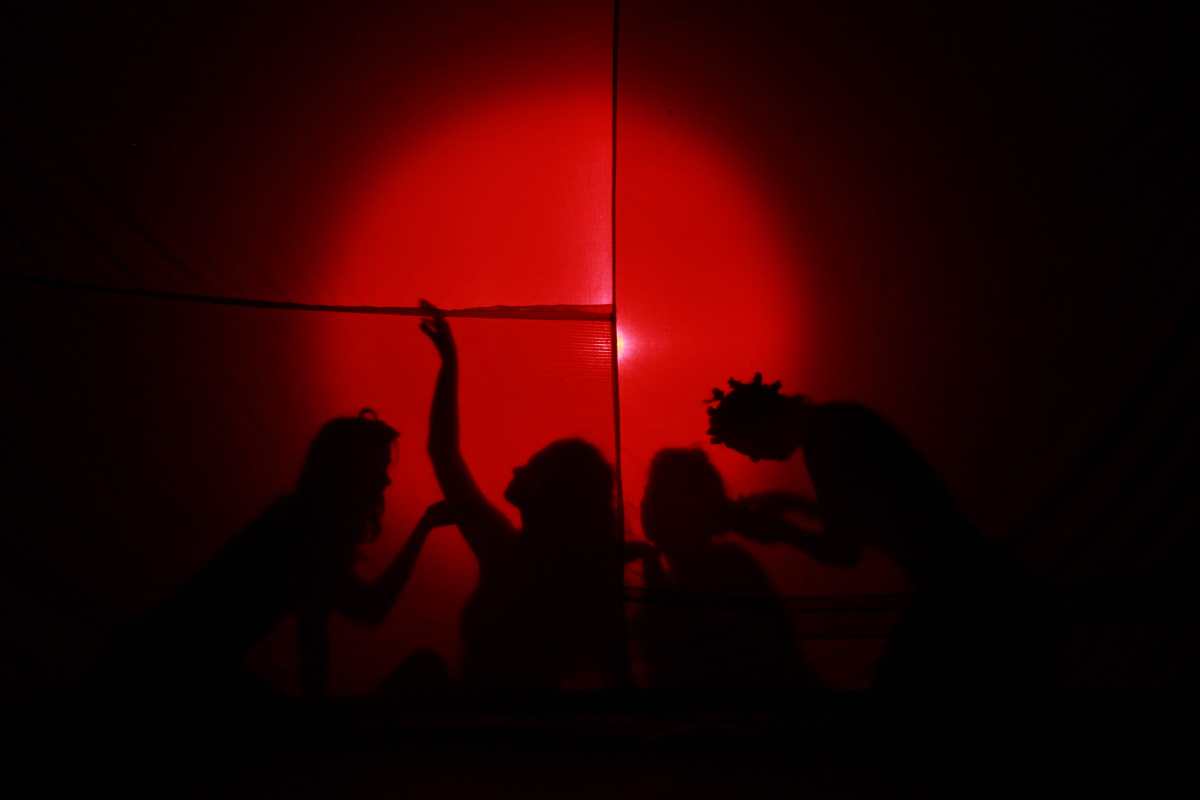
The stagecraft of this piece reflects the conflicted nature of the play itself: the undulations of the underworld are met with the chorus of the Furies themselves as lights and sounds dazzle the audience. Hodgkins-Sumner and his crew ought to be commended for their ambition and creativity, as the set pieces – from the ‘shadow prologue’ behind the curtain to the use of colour motifs to differentiate the divinities from the monsters – are largely effective. However, the direction can veer into the realm of the melodramatic, and the piercing sounds and lights sometimes cause extreme discomfort to the audience. In addition, a few of the effects can take away from the delivery of the story. The interactive ‘voting’ part of the story stands out, as it slows down the action of what would otherwise be a very tense scene and forces an awkward set piece into an energetic scenario. Hodgkins-Sumner’s artistic choices are bold, but they don’t all pay off.

But no story can be told without the mouthpiece of the actors, and herein lays the greatest strength of The Furies. The protagonist Orestes (Jestin) is quite convincing as a man of his time, determined to prove himself innocent of any crime while not denying the killing of his own mother. His primary advocate Apollo – played by John Gilchrist – is, in the director’s own words, a “first class misogynist”, and Gilchrist is excellent in adapting to the role. Alex Eaton’s Athena serves as Apollo’s counterpart, and Eaton plays the role of the rational arbiter quite well in one of the strongest performances in the show. Matching her is Kya Mosey’s Fury, who displays a wonderfully poised malice throughout. Unfortunately, a few of the performances in The Furies – such as Paisley Conrad’s Fury and Meg Shields’ Klytaimnestra – are a bit too loud too often, and as a result don’t add all that much to the scenes they inhabit.

The Furies, as a Greek tragedy, is a fascinating beast. It has all of the elements of classical style and all the requisite tropes, but at times the production gets in the way of what is actually being conveyed to the audience. The play grows as it progresses and the emotional stakes of Orestes’ fate reach a crescendo, and the production still hits the mark. The cast and crew of The Furies have taken on a difficult task of bringing the last chapter of the Oresteia to life and they still succeed, despite a few pitfalls.


