
Goodbye, Coburg
“What has happened during this year?” wrote D. McD. Archibald, editor-in-chief of King’s College Record, 1942. “From the end of September through October, students and coeds alike experienced a period of chaos.”
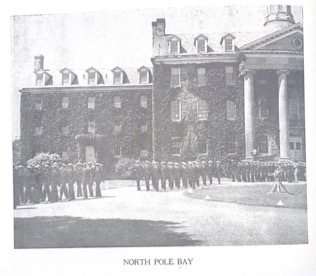
Archibald is referring to what would later be called “the exile.” This was the move of King’s students to Pine Hill Divinity Hall, another school of theology in Nova Scotia, so the Coburg, Rd. campus could be transformed into the “Stone Frigate,” or H.M.C.S. King’s, an officer training establishment.

Answering the Call
During the Second World War, the need for qualified officers was high and outpaced the military’s existing training facilities. Universities and colleges across the country were called to service to help meet this dire need.
In May 1942, King’s president Rev. Dr. A. Stanley Walker summarized these proceedings: “After many meetings and discussions,” he wrote, “an agreement was made. Our next problem was how to carry on.”
H.M.C.S. King’s saw the graduation of about 3,100 officers from its 12-week naval navigation and communications training programs. It began operating in May 1941 and ran for four years. Regular classes on campus resumed for the fall semester in 1945. During that time, the school played an important role in a number of wartime efforts.
King’s helped to discredit German propaganda. It was common for the German army to publish what ships had been sunk to hurt allied morale. To combat misinformation, the names of fake ships, like the H.M.C.S. King’s, were spread by allied forces. When King’s appeared on the list, the allies could officially discredit the propaganda. The reputation of King’s grew and the school was even featured in the 1943 movie Corvette K-225, starring Randolph Scott, Ella Raines, and Robert Mitchum.

Pine Hill Days
The war reached every arm of student culture. In The Record (like The Watch of today), students published short stories and poems about the war. Advertisements featured tailors skilled in officers’ uniforms. It even published which King’s students were away to fight. President Walker emphasized this strangeness to students in November, 1942, more than a year after the move: “We too are definitely on a war front.”
Still, life goes on. The exile, as many called it, found a rhythm and culture one could expect in any near-normal university experience. Dances were held, King’s and Pine Hill students mingled harmoniously, and The Record was published each month to cover it all.

A New Epoch
By the 1945 Encaenia, this strange period drew to a close.
President Walker wrote inis “President’s Report” for The Record that the end of H.M.C.S. King’s was near,and the school may “open the new year once again in our own buildings.” After four years away, he noted, there may not have been a single returning student who remembered the original campus , as four years is the common length of many university studies. “This means,” wrote Walker, “that we start again rebuilding the life and traditions of the College, and so projecting ourselves into a new epoch.”
Today, King’s holds many reminders of its brief time as one of His Majesty’s Canadian Ships. Our beloved Wardy, once the Girl’s Reception Room, is named for its time as the officers’ “Wardroom.” The masthead in the quad, and the painting of officers surrounding it in the library, are also tokens of this strange, special time.
Fires, war, and disease have all knocked on the walls of our school. King’s, although it has changed much over the years, has survived it all. Its student body preserves a legacy of strength and determination. So, next time you’re at the Wardy, or following the Hemingway guide to writing, pour one for your fellow Kingsmen. Many walked the same halls we do today, and some never got the chance.


