
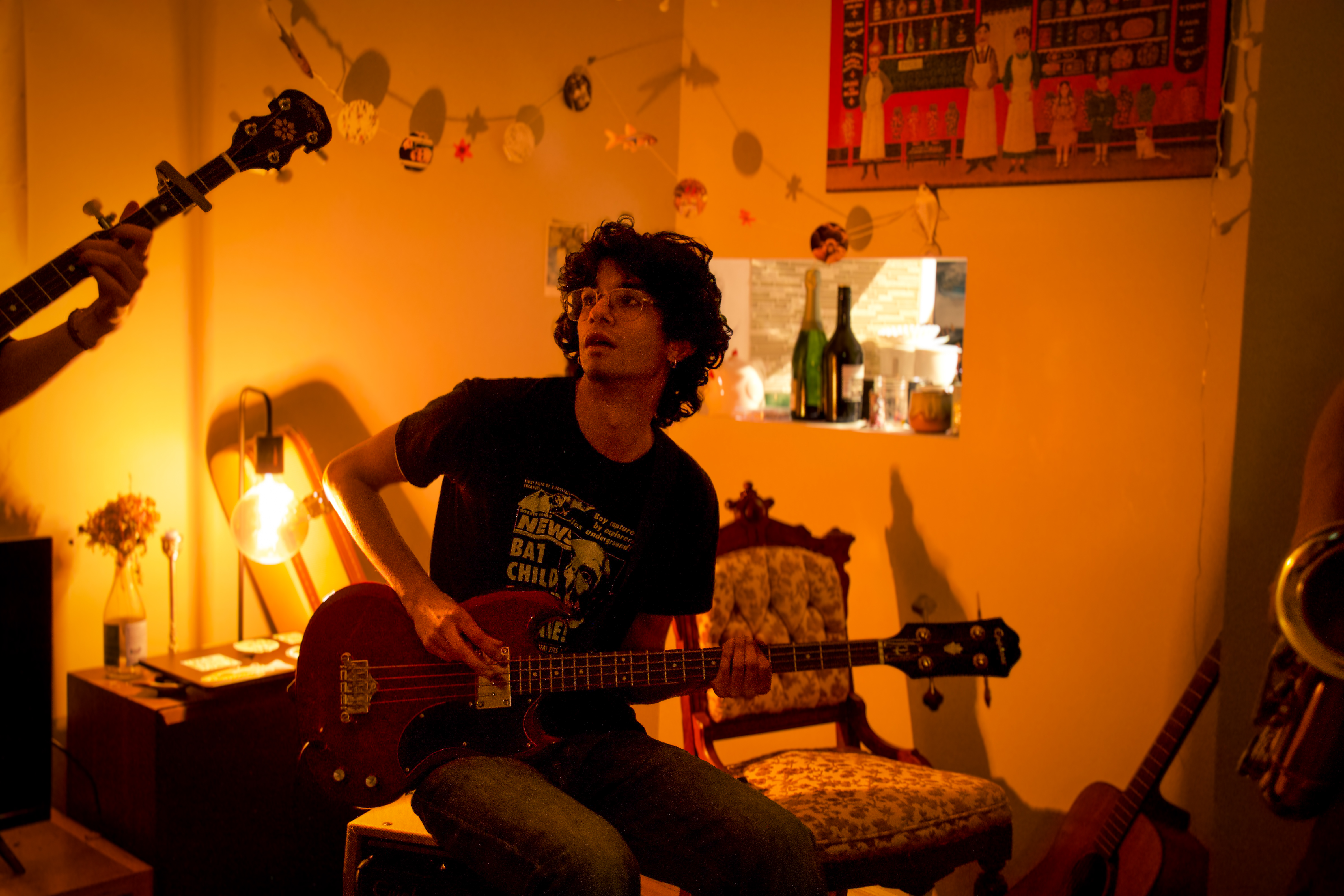
I count seven instruments scattered throughout the room — two guitars, a banjo, tambourine, violin, bass and saxophone. The members of Doghouse cram themselves into their living room, the light from the handful of yellow-toned lamps casting the inhabitants in a warm, lively glow. They balance on the arm of the couch, lean up against the wall and hover in the doorway; staggered in height, carefully angling their instruments to avoid smacking a bandmate with a wayward fretboard or bowling over the mic stand.
Doghouse is a four piece band, usually — Claudiane Beaudoin, Emil Capilongo Anthony, Ben Zumbasen and Jasper Goldie — but right now they’re also joined by Wolfe Baird on saxophone.
The band became official around a year ago, when they were asked to play as an opener for Marmoset in the Wardroom. Infamously and a little disastrously, that show ended outside in the rain — due to a fire hazard that had the venue evacuating, the band scrambling to get at least a few songs played on the library steps before their ticket into the student body’s public consciousness slipped back out of reach.
Back in the living room, there’s a strange, frenetic energy as the band rehearses. Equal parts anticipation and nervousness, they radiate a twitchy, awkward anxiety between songs. Then they start to play and you realize this is them at their best, as all that youthful uncertainty falls away, leaving just five musicians whaling around a coffee table, lucky enough to live with neighbours perpetually too stoned to complain about the noise.
II.
A different living room; a little less cramped, but we squish onto the same blue couch regardless of space. It’s just me, Claude and Ben, this time — an attempt to better flesh out the band’s history.

“[Emil and I] went to high school together in Toronto,” Ben says, “but we weren’t really friends because he was too tall.”
Wait, what? He was too tall?
Ben nods, solemn, for all intents and purposes appearing serious about this. “He was too tall. Whenever we had conversations, it was really awkward because I had to look up really high and it made me really uncomfortable.”
What’s changed? Did you just grow?
“I don’t think I grew, but … I don’t know, something changed. I gave him another shot and I decided that he’s a lot more than his height.”
“He’s actually the first person I had a meal with,” Claude jumps in to add.
A meal with Emil?
“A meal with Emil. Prince Hall, first year. We had a similar gangliness that made us bond very quickly.”
The main problem with trying to pry answers out of Doghouse is that it is often quite difficult to tell whether or not they are joking. There’s an innately self-conscious quality to every comment that’s uniquely them, a self-referential, ironic humour that can be a little baffling for an outsider to parse.
Changing the subject, I ask about Sadie — my personal favourite of their songs. It’s a jostling, bouncy earworm of a tune that seems physically impossible not to jump around to. Claude takes great joy in informing me that Ben wrote it on the toilet.
What inspired it?
Ben says, “Sadie.” Then, “That’s actually not true because I wrote it about Sarah. But I don’t know a Sarah.”
Okay. Makes sense.
Anyway, apparently the name wasn’t cool enough. Sadie’s better. One of their friends pokes her head through the door when they’re reciting chunks of lyrics for me. ‘I want you on the carpet.’ “Is that sexual?” she asks, curious.
“Um,” Ben says, “a little–”
Seeming harried, Claude cuts him off. “No.”
“No,” he agrees, backtracking hastily.
After a moment, begrudgingly, Claude says, “It depends on who you ask.”
Sadie, besides being a great (possibly sexual) song, is important to the band in large part because it’s the first they’ve written together. According to Claude, “Every single member of Doghouse, temporary and not, was involved somehow.” And to Doghouse, a sense of community is more crucial than anything else. Claude explains this to me while looking, possibly for the first time since we sat down, entirely sincere.
Maybe it’s the Maritime influence that has them so drawn to this idea of community; three kids from Toronto and Montreal, drawn to the East Coast, to indie-folk and Townie, to playing the fiddle and banjo. “Come from aways” that “strive to be a maritime band” — because where else would you go for a future in folk? Where else do you find that community?
III.
The Wardroom is as busy as I’ve ever seen it. It’s Thursday night, 10 p.m., and I’m cross-legged on the floor amidst terrible games of pool and overpriced pitchers of beer, with a lapful of camera and a fistful of Irish Red. There is some serious head-bopping going on in the crowd around me.
Doghouse has just finished a jauntily soulful rendition of Iodine by Leonard Cohen when the opening riff of Sadie starts up. It might be the beer, but for possibly the first time in three years, I am sincerely, unambiguously glad to be in the Wardy.
“I want Sadie in my tummy, I want Sadie in my van!”
They’re incredibly earnest once you get an instrument in their hands, up on stage and under the lights, in a way that feels impossible to predict. Somehow, they seem more comfortable here than they had in their own living room — buoyed, maybe, by the faces of their friends and classmates, the community of people they love and are loved by.
Later, Claude will tell me: “Music is part of what makes me really grateful to be in Halifax. It’s made me see Halifax as a really, really unique and special place to go to university. It’s important to realize that it’s such a tight-knit community, and I’m really glad that I can contribute to that somehow. Being disillusioned by the big city in the past, you gotta realize — gratitude.” And then she’ll burst into sudden, startled laughter, like she can’t quite believe she’d just said that.
For now, I sit among the crowd of still gangly, awkward barely-adults struggling indefinitely under the pressing weight of a waning adolescence and let myself feel grateful. For Halifax, music and love, the way it bubbles in your chest and presses against your sternum, beating in time to every strum of the banjo.