
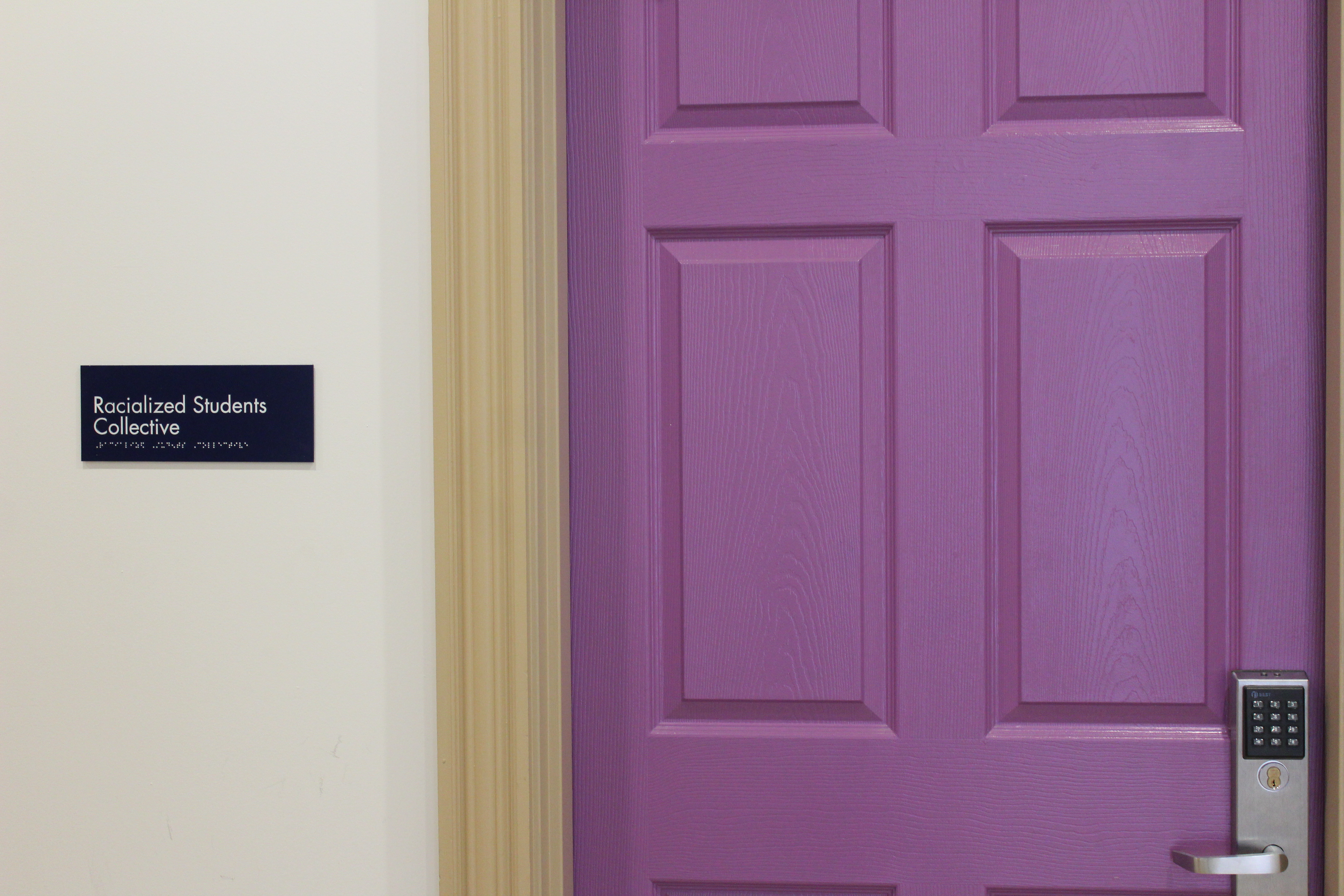
“It’s not just a purple door anymore,” says new RSC coordinator
The Racialized Students Collective (RSC) has been revived after nearly four years of inactivity. The collective, which runs adjacent to the KSU, aims to build community among the racialized student population at King’s and provide resources and support.
Iman Mannathukkaren, current external vice president of the KSU, and Aniqa Jalal, former communications vice president of the KSU, spearheaded the revival last year.
“Last year, one of my friends who used to be on the union was already ready to get the RSC revived,” said Mannathukkaren. “The two of us were discussing it, but many of us on the union had low capacity last year.”
Mannathukkaren chaired the hiring committee for the RSC Coordinator and the process began in November.
“The idea was to have someone in charge of running it over the course of this year, so that it’d have a dedicated and permanent presence and have someone who has the capacity to fully focus on it and be able to build it according to what students would like to see,” said Mannathukkaren.
As a racialized student herself, Mannathukkaren has a personal investment in the revival of the RSC.
“I think being able to have a more tangible community that is more long-standing and permanent provides a much stronger barrier against alienation to students of colour,” she said. “It’s important to provide a space where you can just go talk, vent, laugh, whatever you need to fill that gap in community.”
The committee hired Keziah Artry, a second-year international development student, as RSC Coordinator.
Artry has been tasked with organizing monthly events, advocating for racialized students and building the collective according to students’ wants and needs. She is also working to revive the RSC Room, a closed space that she says has been underused.
“When I came [to King’s] last year, the RSC room had a big sign on it saying something like out of order [or] not in function,” said Artry. “It’s a problem when it’s been promoted as a space, and then I come to the school and see that.”
Artry has been hard at work. The RSC’s first event post-revival was a happy hour student mixer in the Wardroom on Feb. 26 and Artry said the turnout was great. She is in the process of planning another event, working with the Galley to provide free drink coupons to RSC members and revitalizing the RSC Room. She is also in the process of digitally cataloguing the RSC’s valuable but underused library.
Artry knows what racialized students experience in King’s predominantly white environment.
“Coming to King’s, I thought maybe this would be a different experience [from high school], that I would have diverse friends,” she said. “That just wasn’t the experience I got. I was, unfortunately, the butt of the joke many times for people who were not racialized.”
“The most important thing to me has always been community. With the RSC, I want to help foster that community, have that community space. It’s so important. Especially when incidents like I experienced occur, having that community is really important.”
Artry is optimistic about the future of the RSC and its potential to uplift King’s racialized students.
“The more we show up, the more we’re loud and proud, the more our community will be able to shine and really make an impact here at King’s,” said Artry. “We have amazing, strong, smart individuals.”


