
I would never call myself a religious person, but somehow I found myself kneeling in the snow on the edge of a frozen lake, my hands numb and my head aching in the cold. It was an hour before sunrise — too dark to make out the faces of the people around me, but the golden robes of three figures seemed to glow in the dark woods as they darted back and forth in front of an altar made of snow. The smell of incense hung in the cold air, catching in my throat as I tried to sing along to words I did not understand.
I had never taken part in eucharist before, let alone an early morning eucharist called “The Holy Mysteries for the Curious and the Crazed.” When I was growing up, we weren’t devout church-goers: my mom called herself a “recovering Catholic” and my dad could count the times he had been to church on one hand. My childhood best friend believed in God, and I kept waiting for her to grow out of it, the way we grew out of Santa and the Easter Bunny. But she never did. And I got more and more jealous.
I liked to pretend that my nihilistic, atheistic worldview was superior. I pretended I was fine with the idea that humans were completely alone in the universe, that life had no meaning and nothing we did mattered. But I secretly obsessed over what it meant to be human, and I craved the comfort that believing in God would bring me. But I was never able to make that leap of faith.
Over the course of the weekend, chapel theologian Eli Diamond gave a series of lectures on the four cardinal virtues. I have to admit, I struggled to grasp the finer theological and philosophical points. But something he said at the outset of his first lecture lodged itself in my mind for the rest of the weekend: virtues are good ways of being. If the function of an axe is to chop wood, then by chopping wood, it is excelling at its function. Thus, the virtue of an axe is to chop wood. But applying this concept to the “complicated terrain” of the human is more difficult: what does it mean to be human? How do we excel at it? And how can we live well?
Throughout FYP, I was introduced to the idea that the human soul has an innate restlessness. Part of what makes us human is the desire to find a resting place for our homesick souls. Religion is that resting place for some.. But for me, rest is found somewhere else. I’m not a philosopher or a theologian, but I might suggest that excelling as humans is finding what soothes our restless souls. And I don’t think it matters, necessarily, if we take different paths home.
Diamond suggested that we devote so much of our time and energy at King’s to learning the history of thought, that we rarely give ourselves the opportunity to explore our own thoughts and beliefs. Each of us sitting in the room before him, he suggested, had been drawn to the chapel community by our fundamental, perennial questions about what it meant to be human, about the meaning of life, about how to live well. He hoped we would consider these questions throughout the retreat:
“Look into yourselves,” he said, “and look into the people around you.”
During another one of the many services on the weekend retreat, I sat on the floor of the lodge colouring and whispering with a three-year-old kid. A
round us, people were singing and praying. I watched them for a while, their eyes closed, shoulders relaxed, jaws unclenched, faces unlined. Portraits of serenity and joy. Looking back at the kid beside me, carefully drawing circles in red marker, I saw the same expression on his face. I’m sure if I had a mirror, I would see the same on mine.
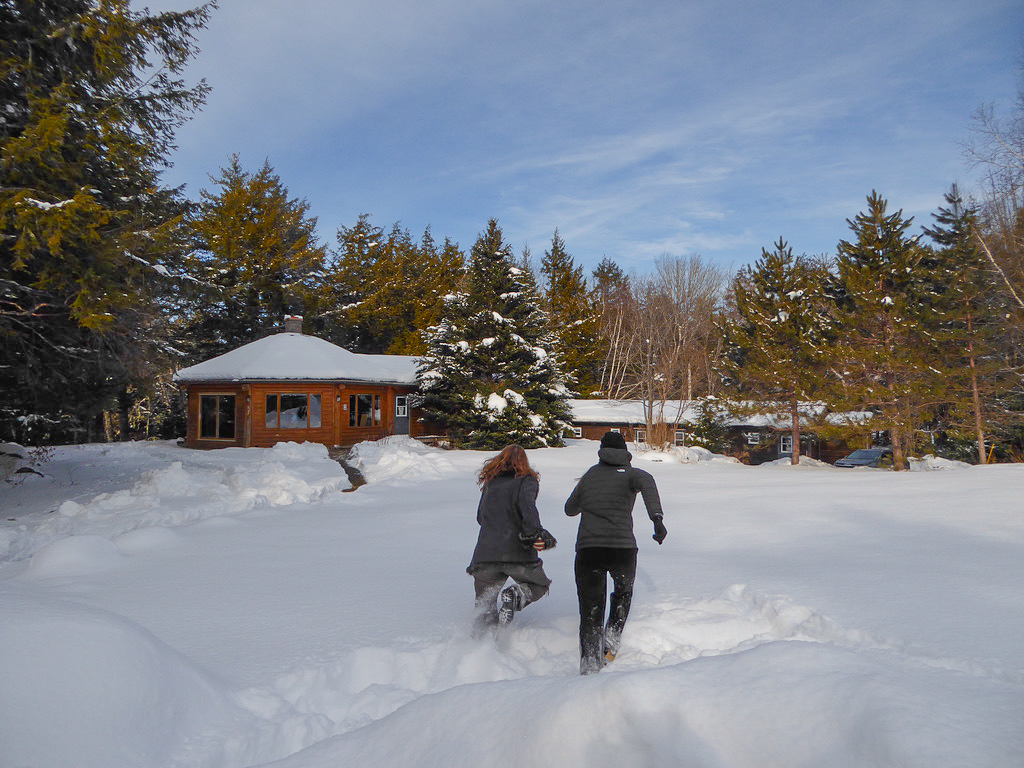
It’s scary to write here that the beautiful services of singing, prayer and lessons were not the moments I felt the most reverent, the most connected to something bigger than myself. Part of me feels ashamed to admit that I didn’t find solace in God. But throwing myself into powdery snow, singing by the fire to four guitars and a harmonica, dunking my head into an icy, blessed lake at sunrise, I felt alive. Standing on the edge of the river, listening to the water rush over the rocks and feeling sunlight stream through the trees and warm my face, I felt holy. Being out under the stars, candle in hand, looking across the lake to another cluster of candles, hearing the song floating through the forest and up into the sky, permeating the darkness — maybe it wasn’t God or the One or the Creator, but I felt a connection with something.
I know next to nothing about theology or philosophy or religion, and I still don’t know if I believe in any sort of spirituality. But I’d guess that living well has something to do with openness. By admitting that I was curious, allowing myself to be surprised and opening my soul to something new, I was able to carve out a place of solace and tranquility and bliss, and quiet the restlessness in my soul.


