
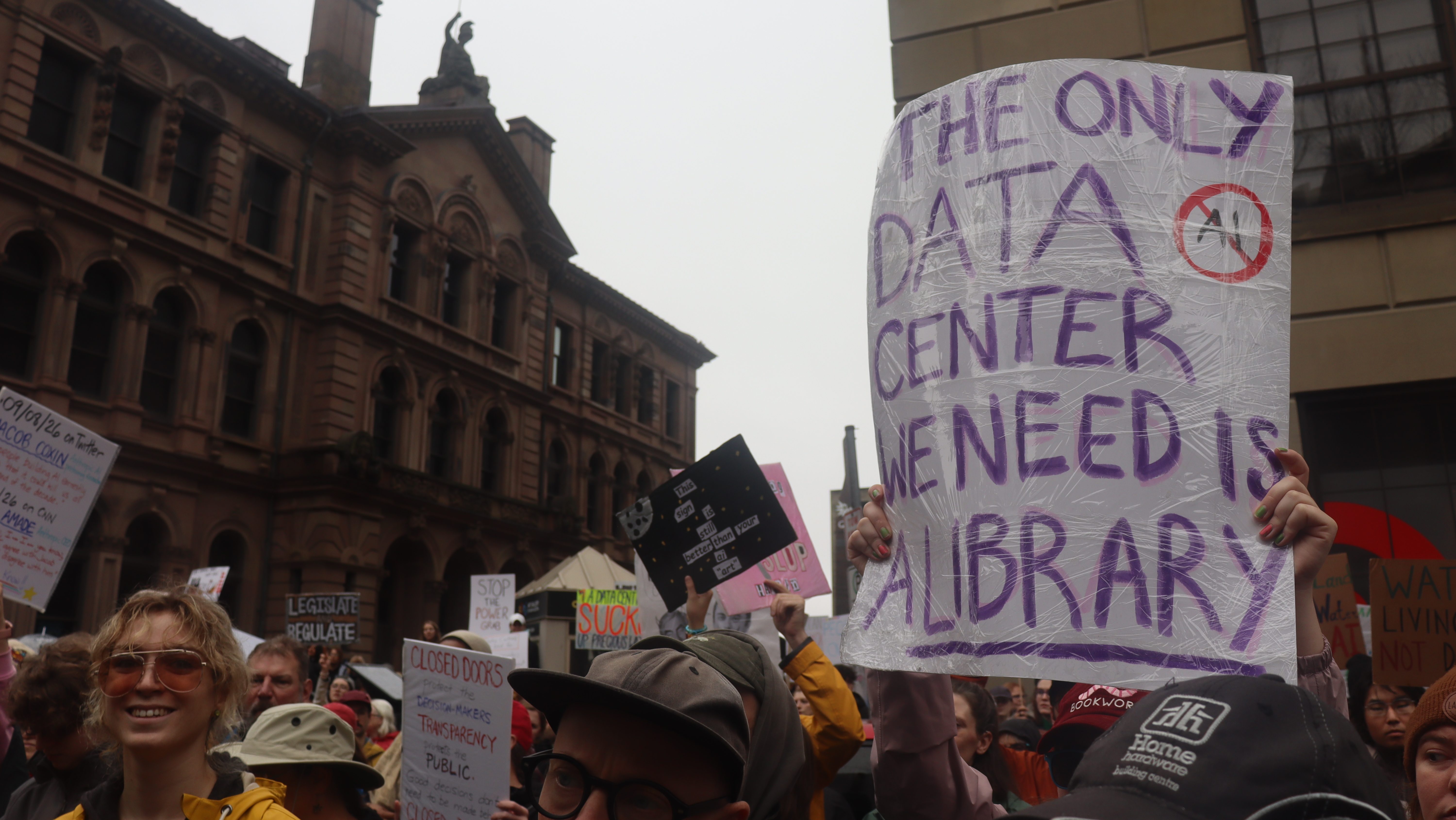
Thousands gathered across Nova Scotia in November to protest EverWind Fuels’ plan to build a data centre in Cape Breton to power Anthropic’s AI agent Claude.
Amid the protests, some Nova Scotians are cashing in.
Brennan Campbell and Alex Melendy are economics and finance (respectively) students at SMU. They own an AI consultancy firm that helps small businesses implement AI into their organizations.
Campbell has been invested in AI for years, while Melendy invested as soon as he turned 19. They describe themselves as “avid AI users.”
“The best performing stocks of the past few years have been AI-related stocks,” Melendy said.
Melendy disagrees that AI is a stock market “bubble” that will burst. He says it’s nothing like the burst of the 2000’s dot-com bubble.
“The issue then was that the prices of certain assets don’t match its underlying value,” said Melendy. “That’s not the case we’re seeing right now.”
Melendy says Anthropic is “the fastest growing company ever.”
“Maybe prices will continue to skyrocket, and in that case, we’ll enter a bubble. It’s definitely something that I’m conscious of, as everybody involved with AI is, but I’m just playing it by ear,’ he said.
Uncertainty is just part of investing, said Campbell.
“There is no return without risk,” he said.
Melendy says the proposed Anthropic data centre is a “massive’ opportunity for Nova Scotia to grow its economy.
“Nova Scotia famously has a very weak economy… it’s a massive opportunity to actually capture some of the greatest economic growth of all time,” said Melendy.
Melendy says EverWind has been given certain conditions by Premier Tim Houston to continue the project. Any costs associated with an increase in energy must be take
n on by the data centre.
“The question here isn’t ‘Are you pro-AI data centre or are you anti-AI data centre?’ The question is, can Nova Scotia actually capture some of this economic growth while mitigating the downsides?” said Melendy.
Campbell and Melendy would also like to see profit from the data centre be invested back into the community.
Both have spent the past two years being involved with Square Roots, Canada’s largest student-led social enterprise, supporting food insecurity across Atlantic Canada.
Melendy says the program has diverted “over a million pounds of produce” from being thrown away.
“We have a very vested interest in ensuring that funds are being allocated properly,” said Melendy.
Both men recognize the climate impacts of data centre, and the amount of fossil fuels they burn. Campbell highlights how other industries, like agriculture and golf courses consume far more water than data centres.
“It’s politically attractive to blame data centres, but I think it’s a larger issue that comes down to the fossil fuel consumption in North America,” said Campbell.
“I think the potential benefit here is raising awareness about how easy it is to negatively impact the environment through things that we deem casual,” said Melendy.
He points to other “casual” things, like a single McDonalds hamburger, that he says uses the equivalent amount of water as “around 50,000 AI prompts.”
Melendy and Campbell are still open to conversations surrounding AI, and its impacts.
“My hope is that, in spirit of open debate, and conversations like this, we can encourage more people to be comfortable bringing forward their views,” said Melendy. “And being open-minded to hearing the perspectives of others.”
“I’m not under the assumption that I’m right and everybody else is wrong. I’m here to understand more,” echoed Campbell.


