
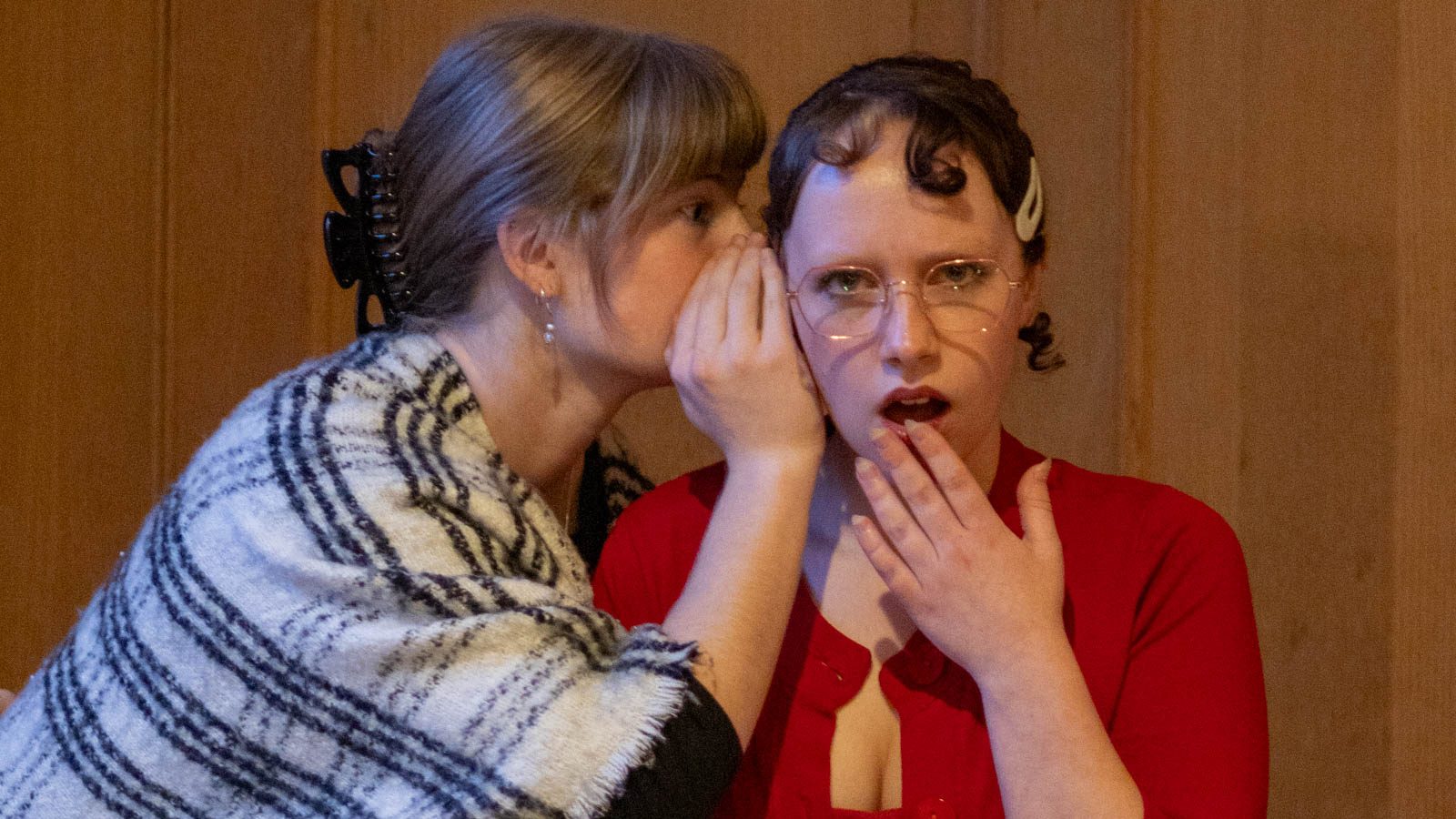
Standing in the KSU office, Jane watches as her TA unravels the condom and uses their teeth to tear it down the middle.
“Now it’s a dental dam,” the TA explains, unfolding the torn condom into a rectangle. “And you can use the rim as a hair elastic. That’ll come in handy.”
The next time I see Jane, she’s slamming a box of 60 dental dams down on the table and relaying her story to me. We liken it to a bad porno set up — how often is it that you see your TA turn a condom into a dental dam with their teeth?
But maybe that’s the problem.
If you went to a progressive high school, maybe you were told that dental dams are the condoms of oral sex — the condoms of lesbians. Maybe there was one in your orientation pack when you arrived at King’s, or maybe you picked one up from the Link and unwrapped it in the dining hall with your friends, ogling the flimsy, slippery latex.
But have you ever actually heard of anyone using one? We hadn’t. To us, the dental dam was this mysterious, almost mythological curiosity. Until that TA in the KSU office, no one had ever made an effort to teach us how to use it.
That was the purpose of Jane’s mission to find dental dams, the reason why we began leaving them all over campus and forcing them into the hands of our friends, begging them to give it a go. We wanted to know — what’s the dam deal?
As it turns out, the deal ain’t that damn good.
We devised an anonymous survey for people to fill out after using a dental dam. Here’s what they had to say.
Many respondents said that the physical barrier of the dental dam, which is much thicker than a condom, dulled the sensory experience of oral sex.
“It felt like I was getting eaten out through a pair of lululemon leggings and when I was going down on my partner, I felt like I was going down on a mannequin.”
“It feels like when you’re getting bad head and have to learn to psychologically get yourself off on scraps. You can’t really feel anything; it feels like a ghost of a feeling.”
The experience wasn’t only dull for the receiver:
“It’s less awesome when you can’t feel the wetness or taste your partner.”
“The sensory experience of performing oral sex is my favourite part of having sex. With the dam, two of my senses were inhibited which was less than ideal for me. The feelings that I usually experience on my tongue were dulled by the dam.”
The dam is also opaque — you can’t see what you’re working with.
“It was harder to locate various geographical landmarks on my journey (certainly not impossible though).”
“It’s opaque so when you’re using it you’re just completely lost. I was honestly just fishing around like, ‘well maybe this is a clit? I’m not sure.’”
Unlike a condom, which is pretty hands-free, one partner has to hold the dam in place.
“The wetness made the dental dam slip around a lot. It was unwieldy.”
“It was hard to hold it there myself which was definitely a let down because hands were more occupied and less roaming occurred.”
Most respondents said that it was “good as an experiment,” but that they wouldn’t want to use it on a regular basis.
“It was fun as an additional thing for one day when it didn’t really matter but it would suck if we were actually using it for the intended purpose.”
“ts pmo icl. There was a fun vibe to it though, I like to try new things with her and it’s fun to have silly sex.”
And most people didn’t use the dam the whole time:
“This might be TMI but she took it away to finish the act because it was just getting in the way and I think it would have been hard to finish while using it.”
“We tried to make stuff happen but the dam of it all didn’t last very long.”
One respondent, who used the dental dam to “perform analingus,” said, “it was nice to have the comfort of separation between my mouth and potential fecal particles.”
According to the National Institutes of Health, it’s more common for people to use dental dams for hygienic reasons like this than with the goal of preventing the spread of STIs. Which might be good, because there have been no clinical studies on the efficacy of dental dams in preventing STIs.
Originally invented for dental surgery in 1864, the repurposing of dental dams for sex came about during the AIDS crisis. Queer women found themselves surrounded by HIV patients and saw resources being spent on HIV prevention among gay men, while women were being largely ignored, wrote Juliet Richters and Stevie Clayton in their article “The practical and symbolic purpose of dental dams in lesbian safer sex promotion.”
However, the evidence of HIV spread between queer women was minimal. And today, we know that most STIs have lower rates of transmission through oral sex. But AIDS service organizations found themselves in a tricky situation: “if they did nothing, even where there was minimal evidence of need, they were seen as ignoring and marginalising women,” Richters and Clayton write.
And so they began giving out dental dams. Thus it seems, as Richters and Clayton put it, that “the provision of dental dams is a knee-jerk reaction to the theoretical risk of STI transmission between women, based on an assumption that they are equivalent to condoms for sex between men.”
The dental dams we got from the KSU office were expired — no one was taking them anyway, so they stopped giving them out.
We aren’t doctors or sex educators or dental dam experts. We aren’t here to tell you if dental dams work, or if you should use one. But what we can tell you is that we aren’t talking about them enough. There have been no clinical studies on their efficacy, no innovations of the product — other than making them colourful and flavoured.
The main complaints we got in our survey seem fixable: the dams are too thick, too opaque, too difficult to hold. Condoms have been improved dozens of times since their inception — surely someone, somewhere could design a better dental dam.
We could harp on about the lack of funding and attention to women’s health and pleasure. We could come down hard on the institution, the patriarchy. But we’re pretty sure you all already agree with that, and there’s something else we want to talk about.
When we gave out our dental dams and explained our project to our friends and classmates, a couple people looked at us with disdain. Some joked we were outright perverse, for asking them to have sex and then tell us about it. We even did it ourselves, laughing about the TA showing Jane how to use a dental dam.
The word ‘perverse’ is what’s sticking in our minds. Oxford Learner’s Dictionaries define the term as “not thought to be normal or acceptable by most people,” while Merriam-Webster says it means “turned away from what is right or good.”
But thinking back through history — who do we entrust to decide what is right and good and normal? Who gets to decide what’s perverse?
Now seems like a good time to remind you that, before it was taken up as a pejorative, the word queer meant “strange, peculiar, differing in some way from what is usual or normal.” Let’s not forget that, less than half a century ago, the word ‘queer’ was synonymous with the word ‘perverse.’
The othering that came with that label of perversity is what allowed the AIDS crisis to be treated not as a public health emergency, but as a morality problem: it was a gay disease, a punishment for the sexual deviance of gay men. When perversity is moralized and used to label someone as “other,” it makes it much easier to look away. And people did look away, while millions died.
By definition, queerness is perverse. It’s strange and peculiar and improper; it makes you unpalatable, obscene, deviant. That’s kind of the whole point: to live a queer life means to turn away from the life society expects you to have, to reject the old norms, the old values, the old world. Queerness demands you to create a new world for yourself, to find a new way to live.
And as we build that new world, turning that same moralizing eye onto ourselves and our own communities only reflects back the violence queer individuals have always faced. We might not be able to say for certain whether or not dental dams make our community safer, but we are definitely made safer when we are able to talk about them, to share in our deviance and test the boundaries of ourselves, of our world.


